ON THE JELLICOE ROAD by Melina Marchetta


BIBLIOGRAPHY

Marchetta, Melina. 2006. ON THE JELLICOE ROAD. Narrated by Rebecca Macauley. Audiobook Download. Audible.com.Victoria, Australia: Bolinda Publishing Pty Ltd. ISBN 9781742011097.

PLOT SUMMARY

Seventeen-year-old Taylor Markham has lived on the Jellicoe Road since she was abandoned by her mother at a 7-Eleven. Mistrustful of all relationships, her faith in Hannah, the one adult Taylor feels closest to, is tested when Hannah unexpectedly leaves town. Taylor is not only leader of her boarding school house, but also the Jellicoe School faction in the annual territory wars against the Townies and the Cadets.

The book is not just Taylor’s story; it is also about five friends – Webb, Narnie, Tate, Fitz and Jude – whose story begins with a fatal car crash twenty-two years before Taylor is made head of Lachlan House. As Taylor tries to find out what happened to Hannah while managing the territory war negotiations, she pursues the trail of clues that will lead her to answers about who her mother is and why she left Taylor on the Jellicoe Road.

CRITICAL ANALYSIS

Taylor’s complicated story line is made even more difficult to follow by the tale of Webb, Narnie, Tate, Fitz and Jude that is periodically inserted as out of sequence pages from a manuscript written by Hannah. The story may be hard to follow, but readers who stick with it will learn all the secrets of Taylor’s past and why Hannah’s manuscript is important.

Although set in Australia, all young adult readers will be able to relate to Taylor’s insecure inner self that is masked by a tough, seemingly uncaring exterior. “It’s the power Raffaela has always had and maybe that’s why I’ve spent most of my life pushing her away. Because being so dependent on people scares me.” In fact, all the characters in the book, to some extent, seem to be looking for a sense of place and belonging.

Marchetta weaves a contemporary realistic tale of love, loss, grief, secrets, truth, friendship and acceptance. It is a story of finding home, “Where they would all belong or long to be. A place on the Jellicoe Road.” This 2009 Michael L. Printz Award winner for excellence in Young Adult literature is a recommended read.

The MP3 unabridged audiobook version of this story was difficult to follow in the beginning. For one thing, the heavy Australian accent of narrator, Rebecca Macauley took some time to get used to. Also, while Macauley did a fair job of giving an individual voice to the female characters, her male voices tended to speak in the same flat monotone that, while a minor annoyance, made it hard to tell who was speaking. Before realizing that the transition from Taylor’s story to Hannah’s manuscript was cued by music, the story was difficult to follow and initially several tracks had to be replayed. After becoming accustomed to the Australian accent and the musical cues, the story was much easier to follow and well worth getting past the initial inconveniences.

REVIEW EXCERPT(S)

BOOKLIST: “…when Marchetta isn’t forcing epiphanies, she has a knack for nuanced characterizations and punchy dialogue. The complexity of the backstory will be offputting to younger readers, but those who stick it out will find rewards in the heartbreaking twists of Marchetta’s saga.”

HORN BOOK: “Suspenseful plotting, slowly unraveling mysteries, and generations of romance shape the absorbing novel.”

KIRKUS REVIEW: “Marchetta plows into a complicated story line head first, shifting between Hannah's narrative and Taylor's trials as Jellicoe School's war commander. Time flashes forward and back, histories bleed together and two generations of friends bear uncanny resemblances to one another. Readers may feel dizzied and disoriented, but as they puzzle out exactly how Hannah's narrative connects with Taylor's current reality, they will find themselves ensnared in the story's fascinating, intricate structure. A beautifully rendered mystery.”

CONNECTIONS

Other books by Melina Marchetta:
Marchetta, Melina. SAVING FRANCESCA. ISBN 0375929827.
Marchetta, Melina. LOOKING FOR ALIBRANDI. ISBN 0375836942.
Marchetta, Melina. FINNIKIN OF THE ROCK. ISBN 0670072818.

Other Michael L. Printz Award winners:
Green, John. LOOKING FOR ALASKA. ISBN 0525475060.
Yang, Gene Luen. AMERICAN BORN CHINESE. ISBN 1596433736.
McCaughrean, Geraldine. THE WHITE DARKNESS. ISBN 0060890363.

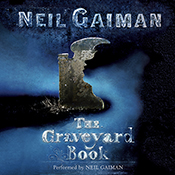
THE GRAVEYARD BOOK by Neil Gaiman


BIBLIOGRAPHY

Gaiman, Neil. 2008. THE GRAVEYARD BOOK. Narrated by the author. Audiobook Download. Audible.com. New York: Harper Children’s. ISBN 0061707392

PLOT SUMMARY

While his family is being murdered by the man Jack, a young toddler escapes from his crib and makes his way outside through the open door. Finding his way to the graveyard up the hill, the boy is taken in by the ghosts of the graveyard inhabitants and protected from those who intend him harm. Adopted by Mr. and Mrs. Owens and given the name Nobody, Bod for short, the child is given the Freedom of the Graveyard.

The dark and mysterious Silas, another inhabitant with the Freedom of the Graveyard assumes the role of Bod’s protector and provider since he can leave the graveyard, while the other spirits cannot. As Bod grows up learning his ABC’s on the headstone inscriptions, he also learns more about the circumstances of his family’s death. The older he gets, the harder he is to protect until one day the Jacks who want him dead find him in the graveyard. With his protector away, Bod must use all the graveyard skills he has to outwit them.

CRITICAL ANALYSIS

While at times this fantasy novel might be somewhat scary for younger children, all young readers will wish at some point that they could live in a graveyard too. Gaiman paints a vivid picture of the graveyard and its inhabitants – who are introduced by the inscription on their headstone. Middle school children and young adults can relate to Bod’s experiences of leaving the safety of home, attending school, encountering bullies, and learning the life-lessons that all adults are not worthy of trust and at some point you have to make your own way in the world. While explaining to Silas his desire to attend school outside of the graveyard Bod observes,

“I’ve learned a lot in this graveyard,” said Bod. “I can Fade and I can Haunt. I can open a ghoul-gate and I know the constellations. But there’s a world out there, with the sea in it, and islands, and shipwrecks and pigs. I mean, it’s filled with things I don’t know. And the teachers here have taught me lots of things, but I need more. If I’m going to survive out there, one day.

It is not hard to see why this book was named as the 2009 Newbery Medal winner. Gaiman has crafted a book that while dark with the themes of murder, ghosts, ghouls, and treachery also manages to be uplifting with the themes of love, friendship, family, and good triumphing over evil.

The unabridged MP3 format of this audiobook is 7 hours and 44 minutes long, and each minute spent listening to Neil Gaiman narrate his book is well spent. Considering Gaiman’s writing style and the heavy reliance on dialogue to carry the story, there is probably no one better than the author to perform the narration. Gaiman gives his characters the individual voice and character that he envisioned in his writing.

REVIEW EXCERPT(S)

HORN BOOK: “After fortuitously escaping the murder of his family, a toddler is taken in by the ghostly denizens of a local graveyard. Growing up in this strange setting entails many adventures, leading to a final showdown with the murderer. Occasional art enhances the otherworldly atmosphere with a flowing line and deep grays and blacks. This ghost-story-cum-coming-of-age novel is both bittersweet and action-filled.”

KIRKUS REVIEW: “Childhood fears take solid shape in the nursery-rhyme-inspired villains, while heroism is its own, often bitter, reward. Closer in tone to American Gods than to Coraline, but permeated with Bod's innocence, this needs to be read by anyone who is or has ever been a child.”

LIBRARY JOURNAL: “Why It Is a Best: An elegant combination of Gaiman's masterly storytelling and McKean's lovely drawings, this book also works as a series of independent but connected short stories set two years apart, following Bod from age two to 16. Why It Is for Us: In interviews, Gaiman has said that this book took him years to write, and it was worth the wait. Imagine Kipling's The Jungle Book set among a forest of graves.”

CONNECTIONS

Have students compare and contrast Gaiman’s THE GRAVEYARD BOOK to Rudyard Kipling’s THE JUNGLE BOOK.

Other books by Neil Gaiman:
Gaiman, Neil. CORALINE. ISBN 0060825448.
Gaiman, Neil. INTERWORLD. ISBN 0061238961.
Gaiman, Neil. M IS FOR MAGIC. ISBN 0061186422.

Other Newbery Award winners:
Avi. CRISPIN: THE CROSS OF LEAD. ISBN 0786816589.
Perkins, Lynne Rae. CRISS CROSS. ISBN 0060092734.
Schlitz, Laura Amy. GOOD MASTERS! SWEET LADIES! : VOICES FROM A MEDIEVAL VILLAGE. ISBN 0763643327.

DIARY OF A WIMPY KID by Jeff Kinney


BIBLIOGRAPHY

Kinney, Jeff. 2007. DIARY OF A WIMPY KID. New York: Amulet Books. ISBN 0810994550.

PLOT SUMMARY

Greg Heffley chronicles his first year of middle school in a journal, “not a diary,” where each entry is accompanied by a cartoon sketch. Wanting to be popular and a hit with the girls, Greg’s social ineptness holds him back from achieving his dream of popularity. Greg suffers many trials in his first year, such as getting kicked off the Safety Patrol or losing out as Class Clown, but he takes comfort in knowing that at least he is not the guy who “ate the _ _ _ _ _ _.”

CRITICAL ANALYSIS

Middle school students will have no problem identifying with wimpy kid, Greg Heffley. Students will be able to relate to Greg’s wish to be popular, but feeling like it is something that can’t quite be achieved. As for Greg's take on popularity, “Nowadays, it’s a whole lot more complicated. Now it’s about the kind of clothes you wear or how rich you are or if you have a cute butt or whatever.”

Author Jeff Kinney’s childlike cartoons and writing style are consistent with a journal that might be kept by an adolescent boy. The language and thought processes are also typical for a middle school student, such as when Greg writes in his journal, “Let me tell you, it’s not easy writing thank-you notes for stuff you didn’t want in the first place.” Kinney’s illustrations also provide supplementary details and context for the story line.

This is a book that all tweens will enjoy and struggling readers especially can connect with. Short, large print sentences connected by graphic illustrations will keep tweens turning the pages to find out the next unfortunate event that befalls Greg as he tries to make it through each day.

REVIEW EXCERPT(S

KIRKUS REVIEW: “Presented in a mix of legible "hand-lettered" text and lots of simple cartoon illustrations with the punch lines often in dialogue balloons, Greg's escapades, unwavering self-interest and sardonic commentary are a hoot and a half--certain to elicit both gales of giggles and winces of sympathy (not to mention recognition) from young readers.”

PUBLISHER’S WEEKLY: “Kinney ably skewers familiar aspects of junior high life, from dealing with the mysteries of what makes someone popular to the trauma of a ‘wrestling unit’ in gym class. His print debut should keep readers in stitches, eagerly anticipating Greg's further adventures.”

SCHOOL LIBRARY JOURNAL: “Kinney's background as a cartoonist is apparent in this hybrid book that falls somewhere between traditional prose and graphic novel. It offers some of the same adventures as the Web book, but there are enough new subplots to entertain Funbrain followers. This version is more pared down, and the pace moves quickly. The first of three installments, it is an excellent choice for reluctant readers, but more experienced readers will also find much to enjoy and relate to in one seventh grader's view of the everyday trials and tribulations of middle school.”

CONNECTIONS

Students could be encouraged to keep their own journal for a semester or the school year.

Other books in the DIARY OF A WIMPY KID series:
Kinney, Jeff. DIARY OF A WIMPY KID: RODRICK RULES. ISBN 0810994739
Kinney, Jeff. DIARY OF A WIMPY KID: THE LAST STRAW. ISBN 0810970686

Other books about surviving middle school:
Holm, Jennifer L. MIDDLE SCHOOL IS WORSE THAN MEATLOAF : A YEAR TOLD THROUGH STUFF. ISBN 0689852819
O'Dell, Kathleen. AGNES PARKER-- KEEPING COOL IN MIDDLE SCHOOL. ISBN 0803730780.
Moss, Marissa. AMELIA’S MIDDLE SCHOOL SURVIVAL GUIDE. ISBN 1416979875

NUMBER THE STARS by Lois Lowry


BIBLIOGRAPHY

Lowry, Lois. 1989. NUMBER THE STARS. Boston: Houghton Mifflin. ISBN 0395510600.

PLOT SUMMARY

Annemarie Johansen and her best friend Ellen Rosen are growing up in Denmark during the Nazi occupation. Ellen and her family are in danger when the Nazis start relocating the Danish Jews. Annemarie’s family takes in Ellen while the rest of the Rosen family goes into hiding. When the Nazis search the Johansen apartment looking for Jews, Annemarie’s parents convince the soldiers that dark-haired Ellen is their daughter. The following day Annemarie’s mother takes her, Ellen and Annemarie’s younger sister Kirsti to a coastal town where Uncle Henrik, lives. There Annemarie discovers that even though she is only ten years old, she has the capacity for bravery as she helps her friend and other Jews escape by boat to Sweden.

CRITICAL ANALYSIS

The setting of the story is Copenhagen in the historical context of World War II and the plot focuses on the actions of one young girl, her best friend, and her family. Lowry’s characters are recognizable to her young adult audience as real children who run, play and worry about spelling tests. The reader can also get a sense of life in Nazi-occupied Denmark as Lowry includes historical details such as shortages of sugar, butter and leather. Children will be able to relate to the disappointment of no cupcakes as well as Kirsti’s objections to wearing green, scaly shoes made from fish.

This book may very well be a school-age child’s first introduction to the Holocaust and treatment of Jews during World War II. Lowry is able to give a sense of the danger to Ellen, her family, and all Danish Jews from the conversations that Annemarie either overhears or is part of. The closing of Jewish-owned shops is explained to Annemarie as the Germans’ way of “tormenting” Jews not only in Denmark, but other countries.

While the style of the story is simple, the plot is suspenseful. As the story builds to its conclusion the recurring themes of bravery and friendship are brought into focus as Annemarie becomes more aware of the undercurrents of tension and danger around her. Annemarie recognizes bravery in the adults around her, but questions if she could be brave when needed. Her Uncle Henrik tells her, “It is much easier to be brave if you do not know everything.” As Annemarie’s family rises to the challenge of protecting their Jewish friends and neighbors, Annemarie also learns that being brave is doing what needs to be done to help a friend even though it is dangerous and frightening.

In the “Afterword”, Lowry provides additional historical context for her book. The reader learns that a handkerchief treated with a mixture of cocaine and rabbit’s blood was really used to confuse search dogs. Lowry also elaborates on several of the historical references made in the book such as the destruction of the Danish naval fleet and the resistance fighters. This book is a good introduction for children to the Holocaust and treatment of Jews during World War II.

REVIEW EXCERPT(S)

KIRKUS: “A deftly told story that dramatizes how Danes appointed themselves bodyguards--not only for their king, who was in the habit of riding alone in Copenhagen, but for their Jews.”

SCHOOL LIBRARY JOURNAL: The gripping story of a ten-year-old Danish girl and her family's courageous efforts to smuggle Jews out of their Nazi-occupied homeland to safety in Sweden. Readers are taken to the very heart of Annemarie's experience, and, through her eyes, come to understand the true meaning of bravery.

CONNECTIONS

This book is a good introduction to a history unit on World War II and the treatment of Jews.

Other books by Lois Lowry:
Lowry, Lois. THE GIVER. ISBN 0395645662
Lowry, Lois. GOSSAMER. ISBN 0385734166
Lowry, Lois. GATHERING BLUE. ISBN 0618055819

Other books about Jews in World War II:
Frank, Anne. THE DIARY OF A YOUNG GIRL. ISBN 0553296981
Littlesugar, Amy. WILLIE AND MAX: A HOLOCAUST STORY. ISBN 0399234837Gross, Elly. ELLY: MY TRUE STORY OF THE HOLOCAUST. ISBN 0545074940

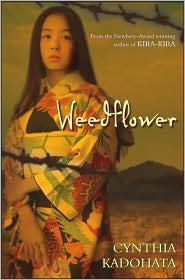
WEEDFLOWER by Cynthia Kadohata


BIBLIOGRAPHY

Kadohata, Cynthia. 2006. WEEDFLOWER. New York: Atheneum Books for Young Readers. ISBN 0689865740.

PLOT SUMMARY

As the only Japanese girl in her class, twelve-year-old Sumiko, already feels different from her classmates because of her ethnic heritage, but after the bombing of Pearl Harbor she realizes the full impact of fear and prejudice as her Japanese-born grandfather and uncle are sent to a prison camp and the rest of the family is relocated to a detention camp in the Arizona desert. Sumiko learns to survive in the desert and resists the temptation to succumb to the “ultimate boredom” which is her grandfather’s term for losing hope and giving up. Like the weedflowers that are grown in the fields instead of in a greenhouse, Sumiko overcomes the hardships of camp life, making a place for herself and keeping her dream of owning a flower shop alive.

CRITICAL ANALYSIS

While this book is fiction, the setting for the story is historically accurate. Thousands of Japanese-American citizens, including the author’s father, were relocated to internment camps during World War II. Kadohata notes in the “Acknowledgments” that in many ways the story of Sumiko is the story of Ruth Okimoto, a former Poston internee who provided personal experience and research information. Kadohata’s descriptive details of camp and desert life will give young readers a feeling for what Sumiko’s life was like.

There was no fence, but, Sumiko realized, there was nowhere to go, either. She'd seen a guard gate when they drove by the first camp, but she didn't see one here. She knew what would happen if someone tried to escape into the desert. They would die of thirst.

Kadohata’s style of writing presents the complex issues of racial discrimination, prejudice, civil rights, and war without overpowering the story line or the reader. Kadohata not only includes discrimination against Japanese-Americans in this story, but also incorporates details of discriminatory practices against Native Americans in the 1940’s.

“Indians were declared citizens by the U.S. government in 1924, but the states decide individually who can vote or not. Arizona doesn’t allow it.” Frank turned to his brother for approval; Joseph nodded.

“I don’t want to vote anyway,” Sumiko said.

There was a silence. Bull said gently, “Still, they should have
the right, Sumi-chan.” Sumiko lowered her head and felt her face heat up again.

The theme of being different and trying to find a place to belong will resonate with young readers. Sumiko’s hurt at being snubbed at a party or embarrassment when singled out because she looks different are experiences that all children feel at some time. Readers will also be encouraged by Sumiko’s unwillingness to give in to the “ultimate boredom” and continue working to improve camp life and not give up on her dreams. Young readers may also be led to consider how Sumiko’s situation might mirror the feelings or experiences of Muslim or Arab-American children in today’s society.

In addition to the “Acknowledgment” at the beginning of the book, Kadohata also includes an “End Note” that provides information about the Japanese-American and Native American soldiers who served in World War II. She notes that at the end of the war Japanese and Hopi lived together for a brief period at the Poston camp. She also includes a note that Arizona granted Native Americans the right to vote in 1948.

REVIEW EXCERPT(S)

HORN BOOK: “The writing is mostly, though not consistently, compelling, with numerous details of camp life seamlessly woven into the story. Kadohata also adds some depth with a friendship between Sumiko and a Mohave boy (the camp is on tribal lands). The low-key tone and subdued dramatic arc fit the story, in which camp life is mainly an uneventful struggle against boredom; the novel also reveals why people such as Sumiko's family quietly accepted arrest and internment. Kadohata again creates a sympathetic, believable young protagonist and a vividly realized setting.”

SCHOOL LIBRARY JOURNAL: “Kadohata brings into play some complex issues, but they realistically dovetail with Sumiko's growth from child to young woman. She is a sympathetic heroine, surrounded by well-crafted, fascinating people. The concise yet lyrical prose conveys her story in a compelling narrative that will resonate with a wide audience.”

LIBRARY MEDIA CONNECTION: “Sumiko's keen observations of life around her and her own personal growth are shared in a quiet, flowing narrative. Middle schoolers will instantly be hooked by the opening: "This is what it felt like to be lonely." Based on the real story of how Japanese-Americans and Native Americans were changed by their contact, this historical fiction title is excellent for discussions of family, friendships, and prejudice.”

CONNECTIONS

This book could be included in a social studies unit on civil rights or a history unit on World War II.

Other books by Cynthia Kadohata:
Kadohata, Cynthia. KIRA-KIRA. ISBN 0689856393.
Kadohata, Cynthia. OUTSIDE BEAUTY. ISBN 0689865759.
Kadohata, Cynthia. CRACKER! : THE BEST DOG IN VIETNAM. ISBN 1416906371.

Other books about the internment camps:
Kent, Deborah. THE TRAGIC HISTORY OF THE JAPANESE-AMERICAN INTERNMENT CAMPS. ISBN 076602797X.
Sakurai, Gail. JAPANESE AMERICAN INTERNMENT CAMPS. ISBN 0516222767.
Gruenewald, Mary Matsuda. LOOKING LIKE THE ENEMY: MY STORY OF IMPRISONMENT IN JAPANESE-AMERICAN INTERNMENT CAMPS. ISBN 0939165538.